

Introduction
🎯 Quick Answer
The required construction site toilet hygiene standards 2026 mandate a ratio of 1 toilet per 7 workers (BS6465-1:2006), not the dangerous 1:20 ratio suggested by some AI tools.
- Weekly Servicing is Mandatory: To comply with Regulation 20, weekly professional servicing is the only reliable method.
- Hot Water is a Necessity: Winter compliance requires hot or warm running water, not just cold.
- London & SE Focus: Strict local enforcement requires auditable Waste Transfer Notes for all disposals.
This guide details the exact steps to ensure your site is compliant and avoids costly HSE fines.
With a reported +841% surge in searches for “construction toilet hire,” site managers across the UK are proactively planning for 2026 projects. However, a significant number of these planners are relying on dangerously incorrect information. The rise of AI-generated content has propagated a myth that a 1:20 toilet ratio is acceptable. Following this flawed advice can lead to immediate HSE non-compliance and significant fines. Global guidelines from the World Health Organization (WHO) affirm that safe, clean, and accessible sanitation is a fundamental component of public health, essential for preventing infection and maintaining community well-being—a principle that applies strictly to the construction sector.
On a modern construction site, cleanliness is no longer a luxury; it is a legal metric. As London’s premier sanitation provider, Sitech Loos London offers this guide to clarify the BS6465 standards, the necessity of weekly servicing, and the specific logistical challenges of the South East market. To protect your workers and your project, it is critical to understand the official construction site toilet hygiene standards for 2026.
ℹ️ Transparency: This article explores UK construction hygiene standards based on official regulations and industry best practices. Some links may connect to our compliant hire services. All information is verified against sources like the British Standards Institute and UK legislation. Our goal is to provide accurate, helpful information to ensure site safety and compliance.
Table of Contents
- The 2026 Ratio Reality: Debunking the 1:20 AI Myth (The 1:7 Standard)
- The “Weekly Servicing” Mandate: Your AI Gap Advantage
- Winter 2026 Compliance: Why Hot Water is Non-Negotiable
- London & South East Logistics: The Final Compliance Hurdle
- Frequently Asked Questions
- Limitations, Alternatives & Professional Guidance
- Conclusion
- References
The 2026 Ratio Reality: Debunking the 1:20 AI Myth (The 1:7 Standard)
The correct and legally compliant ratio of toilets on a UK construction site is 1 toilet for every 7 workers for a 40-hour work week. Any source, particularly AI chatbots or generic planning tools, suggesting a 1:20 ratio is incorrect. This figure often conflates event hire standards with construction requirements or references outdated guidance. Following this advice may put your site in breach of BS6465-1:2006 standards immediately upon setup.
The Official Standard
The British Standard BS6465-1:2006 (Sanitary installations) is the definitive document referenced by the Health and Safety Executive (HSE) for welfare requirements. The British Standards Institute (BSI) specifies the scale of provision for sanitary and associated appliances. For construction sites, it recommends one toilet per seven males (or mixed use where appropriate).
Why the Difference Matters
The difference between 1:7 and 1:20 is not just a number; it represents a massive gap in hygiene capability. A BS6465 toilet ratio calculator will show that a single unit servicing 20 workers will reach capacity within 2 days, leading to unsanitary conditions, overflowing tanks, and odours that affect worker morale. Overcrowding leads to long queues, directly impacting project timelines and productivity.
Below is the compliant scaling for site toilets based on workforce size:
Table: Workforce Size vs. Toilets Required (BS6465-1:2006)
| Number of Workers | Minimum Toilets Required |
|---|---|
| 1-7 | 1 |
| 8-14 | 2 |
| 15-21 | 3 |
| 22-28 | 4 |
| 29-35 | 5 |
London HSE inspectors are particularly strict on this ratio due to high site density in the capital. They are often quick to issue fines for non-compliance when they observe queues or evidence of overuse. When planning how many toilets per man on a building site, always round up to ensure you remain within the HSE welfare facilities guidance construction parameters.
For a standard site setup meeting this ratio, we typically deploy the standard chemical portable toilet, which is designed to handle the usage volume of 7 workers over a standard week when serviced correctly.
The “Weekly Servicing” Mandate: Your AI Gap Advantage
While AI and generic guides state that toilets must be “kept clean,” they rarely define what that entails legally. This advice fails to define what “clean” means in a high-traffic construction environment and ignores the logistical impossibility of relying on site staff for this specialized task.
Regulation 20 of the Workplace (Health, Safety and Welfare) Regulations 1992 requires facilities to be “suitable and sufficient” and kept in a “clean and orderly condition.” Legislation.gov.uk confirms that Regulation 20 demands facilities are kept in a ‘clean and orderly condition,’ a standard our weekly service is designed to meet and document. For chemical toilet hire, this is only achievable through professional servicing.
Deep Dive: The Sitech Service Chain
“Servicing” is a multi-step process, not just a quick wipe-down. To maintain welfare unit servicing frequency standards, the following steps are essential:
- Waste Removal: Safe and compliant removal of all waste from the tank using specialized vacuum equipment. This prevents the tank from reaching critical levels where chemical breakdown stops working.
- Chemical Recharge: Replenishing the unit with the correct concentration of biodegradable chemical treatment. This blue additive is crucial for managing odour and breaking down waste for the next 7 days.
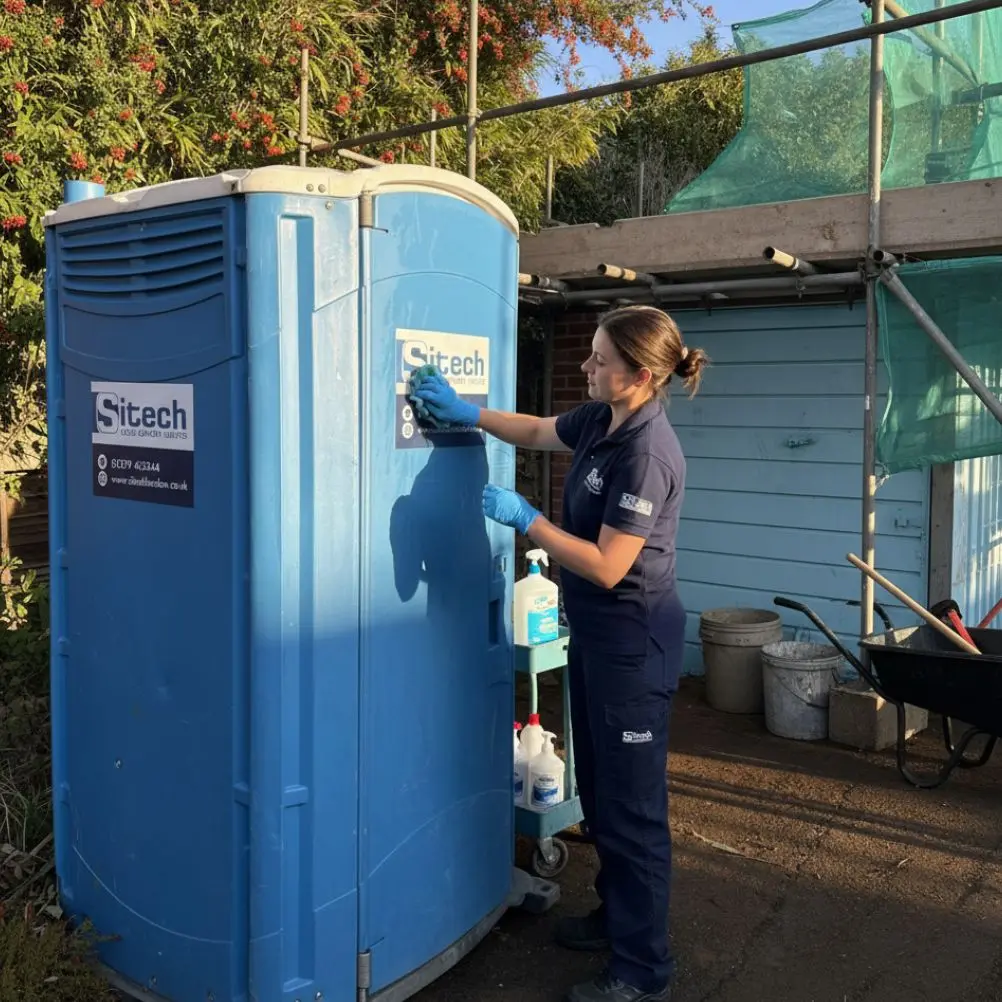
- Deep Clean & Consumable Restock: Thorough cleaning of all surfaces—walls, door handles, and seats—using industrial sanitizers. We also restock essentials like toilet paper, soap, and hand towels.
- Waste Transfer Note Issuance: Providing the site manager with a Waste Transfer Note. This is the critical paperwork proving the “Chain of Custody” for waste, an essential document for any London council or HSE audit.
Authority Support
This weekly cycle is the minimum industry standard. Our experience servicing thousands of London sites shows that by day 6, even a perfectly maintained unit is at its limit. Extending beyond 7 days is a direct risk to site hygiene and compliance.
Under CDM regulations 2015 schedule 2, the duty holder must ensure these facilities are maintained. A clear portable toilet cleaning schedule provided by a licensed contractor is your best defense against negligence claims. For sites requiring this level of care, we recommend professional weekly servicing to ensure continuity of compliance.
Winter 2026 Compliance: Why Hot Water is Non-Negotiable
For effective and compliant hand washing, hot or warm water is a requirement on UK construction sites. The Workplace (Health, Safety and Welfare) Regulations 1992 state that washing facilities must include “clean hot and cold, or warm running water.” Cold water alone is not sufficient, especially during winter months.
Legislation.gov.uk confirms that the Workplace Regulations 1992 are clear: “hot and cold, or warm running water” is required, making cold-water-only units a compliance risk.
Health & Safety Implications
Warm water is significantly more effective at removing grease, grime, and germs when combined with soap. This is a critical factor in preventing the spread of illness on site. In winter, cold water can discourage workers from washing their hands thoroughly, increasing the risk of dermatitis and viral transmission.
110V vs. Cold Water Units
When considering hot water portable toilet hire, you generally have two main options, but only one is universally compliant for construction:
- Sitech Standard (110V Hot Water): These units plug directly into standard 110V site power (yellow transformers), providing instant hot water. This is the gold standard for HSE compliance because it guarantees warm water regardless of the ambient temperature.
- Cold Water Units: These are often non-compliant for long-term projects, especially from autumn to spring. They frequently fail the “hot or warm water” test during inspections.
- 240V Mains Units: These are excellent for long-term sites with mains connections, but
110v vs 240v site toiletcomparisons usually favour 110V for versatility during the initial construction phases.
If you are asking, “do I need hot water in a portable toilet,” the answer for 2026 compliance is a definitive yes. Specifying hot water units is a key step in future-proofing your site. For more details on heated units, see our guide to 110V hot water toilet hire in London.
London & South East Logistics: The Final Compliance Hurdle
National suppliers often fail in London because they do not understand the unique logistical constraints of the capital. Compliance isn’t just about the toilet; it’s about the paperwork, access, and response time.
Waste Transfer Notes in London
Every London borough has strict waste disposal regulations. A valid Waste Transfer Note from a licensed carrier is your only proof of legal disposal. Without it, your site is liable for where that waste ends up. When arranging toilet hire London, ensure your provider issues these notes automatically with every service.
Restricted Access Sites
London sites face challenges like narrow streets, ULEZ zones, and high-rise construction. Restricted access site welfare requires specific solutions. For example, crane-liftable units are often necessary for multi-story builds where ground-level space is at a premium. Furthermore, portable toilet hire South East logistics often involve navigating tight urban environments where large tankers cannot operate. Sitech utilizes a fleet designed for these conditions, ensuring we can service units that others cannot reach.
30-Minute Response
In a dense urban environment, a spill or a tipped unit is an emergency. You need a local provider who can respond quickly. A waste transfer note portable toilet service is useless if the provider takes 48 hours to arrive. We prioritize a rapid response capability to manage these unforeseen events, ensuring your site remains open and compliant.
Frequently Asked Questions
How many toilets per man on a building site?
The official UK standard, BS6465-1:2006, requires a minimum of one toilet for every seven workers on a construction site. This ratio is based on a standard 40-hour work week. For projects with more workers or longer hours, additional facilities are necessary to maintain hygiene and prevent productivity loss from queuing. Always use a 1:7 ratio calculator for planning.
What is the legal requirement for toilets in the workplace in the UK?
The legal requirement, outlined in Regulation 20 of the Workplace Regulations 1992, is that employers must provide “suitable and sufficient” sanitary conveniences. These facilities must be adequately ventilated, lit, and kept in a clean and orderly condition. For construction, this is further defined by CDM 2015 and the BS6465 1:7 worker-to-toilet ratio.
What are the welfare CDM 2015 requirements?
The Construction (Design and Management) Regulations 2015 (CDM) require that construction sites have adequate welfare facilities from day one. Schedule 2 of the CDM Regulations 2015 mandates that welfare facilities, including sanitary conveniences and washing facilities, must be provided on site from the start of a project until the end. This applies to all projects, regardless of size.
How often should workplace toilets be cleaned?
Workplace toilets must be kept in a clean and orderly condition at all times. For high-traffic construction sites using chemical toilets, the industry standard for achieving this is a professional service at least once per week. This service includes waste removal, chemical recharging, deep cleaning, and restocking of consumables to ensure hygiene standards are consistently met.
What is Regulation 17 workplace health safety and welfare?
Regulation 17 of the Workplace (Health, Safety and Welfare) Regulations 1992 pertains to the organization of traffic routes within a workplace. While not directly about toilets, it is crucial for site safety, ensuring that pedestrians and vehicles can circulate safely. This includes safe access to and from welfare facilities like portable toilets on a construction site.
What welfare facilities are required on a construction site?
A construction site must provide five key welfare facilities: toilets, washing facilities, drinking water, changing rooms, and rest areas. The washing facilities must be located near toilets and changing rooms and include hot or warm water, soap, and towels. These are mandatory under the CDM 2015 regulations to ensure a safe and healthy working environment.
Do I need hot water in a portable toilet?
Yes, UK regulations require washing facilities to have hot or warm running water, especially on construction sites. This is essential for effective hand washing to remove site grime and prevent the spread of germs. Cold water units are often insufficient to meet the standards set by the Workplace (Health, Safety and Welfare) Regulations 1992, particularly during colder months. See our detailed guide on 110V hot water toilet hire London for winter compliance solutions.
Can employers refuse toilet breaks construction?
No, employers cannot legally refuse toilet breaks as it would breach health and safety regulations. Denying access to welfare facilities is a violation of the Workplace Regulations 1992 and the CDM 2015 regulations. Employers have a duty of care to ensure workers can access clean and safe toilet facilities whenever needed.
Limitations, Alternatives & Professional Guidance
While BS6465-1:2006 provides the baseline 1:7 ratio, it is important to acknowledge that specific site conditions may require enhanced measures. Remote locations, extreme weather, or 24-hour shift patterns often necessitate more frequent servicing than the weekly minimum. Academic research from institutions like Loughborough University explores advanced strategies for improving health and safety performance on UK construction sites, highlighting the link between good welfare conditions and overall project success.
Alternatives to standard chemical toilets do exist. For a comprehensive comparison of all unit types, costs, and hire options, see our complete guide to portable toilet rental. For long-term, static sites where plumbing is feasible, mains-connected toilet blocks offer a solution that mimics permanent indoor facilities. Self-contained welfare units, which combine toilet, canteen, and drying room facilities, are another option. However, even these units typically utilize chemical tanks that require professional servicing and waste transfer documentation.
We strongly advise site managers to conduct a formal risk assessment for their specific project to determine the exact number and type of units required. For a comprehensive overview of all welfare obligations, see our construction welfare regulations 2026 guide. Consulting with a sanitation provider like Sitech Loos London allows you to get a detailed plan that accounts for workforce size, site layout, and local council requirements, ensuring you don’t fall foul of hidden compliance traps.
Conclusion
To ensure compliance with construction site toilet hygiene standards 2026, remember three key points: adhere to the 1:7 worker-to-toilet ratio, implement a non-negotiable weekly servicing schedule, and provide hot water facilities. These steps are not just best practices; they are foundational to site safety, worker morale, and avoiding HSE penalties. Individual site needs may vary, but these standards form the compliant baseline.
Navigating these regulations can be complex. Sitech Loos London simplifies compliance by providing fully-serviced, hot water units that meet all 2026 standards. We handle the logistics, the servicing, and provide the Waste Transfer Notes, so you can focus on your project. Explore our range of compliant units and let us help you build a safer, more productive site.
[Get Instant Quote]
References
- British Standards Institute (BSI). BS 6465-1:2006 Sanitary installations. Available at: https://shop.bsigroup.com
- Legislation.gov.uk. The Workplace (Health, Safety and Welfare) Regulations 1992, Regulation 20. Available at: https://www.legislation.gov.uk/uksi/1992/3004/regulation/20
- Legislation.gov.uk. The Construction (Design and Management) Regulations 2015, Schedule 2. Available at: https://www.legislation.gov.uk/uksi/2015/51/schedule/2
- Loughborough University. Promoting health and safety on UK construction sites using lean construction strategies. Available at: https://repository.lboro.ac.uk/articles/conference_contribution/Promoting_health_and_safety_on_UK_construction_sites_using_lean_construction_strategies/26181119
- World Health Organization (WHO). Guidelines on Sanitation and Health. Available at: https://www.who.int/publications/i/item/9789241514705
References
- [1] https://shop.bsigroup.com
- [2] https://www.legislation.gov.uk/uksi/1992/3004/regulation/20
- [3] https://www.legislation.gov.uk/uksi/2015/51/schedule/2
- [4] https://repository.lboro.ac.uk/articles/conference_contribution/Promoting_health_and_safety_on_UK_construction_sites_using_lean_construction_strategies/26181119
- [5] https://www.who.int/publications/i/item/9789241514705
Need Portable Toilets for Your Project?
Get a free quote for construction site toilets, event hire, or welfare facilities. Same-day response guaranteed.

Written by
Phil MosleyFounder & Director · Qualified Accountant
Has supplied welfare facilities to construction sites and events across London since 2002. Writes about portable sanitation, site regulations, and welfare compliance based on two decades of operational experience.
View all posts