

Introduction
🎯 Quick Answer
For construction sites in the capital, 110v hot water toilet hire London is essential for winter as it supports HSE compliance by providing warm water for hand washing, helps prevent frozen units, and improves worker welfare in cold conditions.
- HSE Compliant: Meets legal requirements for “suitable washing facilities” even in freezing temperatures.
- Superior Hygiene: Effectively removes site grease and London clay, reducing health risks like dermatitis.
- Winter-Proof: Features a 3kW heater to help prevent frozen pipes and ensure continuous operation.
Continue reading for a detailed comparison, technical specifications, and a guide to London site logistics.
On a typical 2°C London morning, the difference between a compliant, productive site and a welfare failure often comes down to the washing facilities. Standard cold water chemical toilets frequently fail the workforce when temperatures drop; water freezes, cleaning becomes impossible, and hygiene standards slip. This is why 110v hot water toilet hire London has become the professional standard for winter welfare, ensuring that sites remain operational and safe regardless of the weather.
Sitech brings specific experience to London construction sites, navigating everything from tight access in the City to managing ULEZ logistics for timely servicing. This guide covers the technical advantages of heated units, the specific HSE legal requirements they help meet, and the practical differences in performance that site managers need to know. Below, we provide a clear, data-driven comparison to help you make informed decisions for your winter site setup.
ℹ️ Transparency: This article provides technical guidance on winter welfare facilities based on UK regulations and our extensive experience on London construction sites. We cite official sources like the HSE. Some links may connect to our specific product pages. Our goal is to provide accurate, helpful information for site managers.
Table of Contents
- The Winter Gap: 110V Hot Water vs. Cold Chemical Units
- HSE Compliance & CDM Regulations 2015
- Technical Specs: Installation & Power
- London Site Logistics: ULEZ, Access, and Servicing
- Frequently Asked Questions
- Limitations, Alternatives & Professional Guidance
- Conclusion
- References
The Winter Gap: 110V Hot Water vs. Cold Chemical Units
Generic guides often miss the specific performance data required for UK winter conditions. While standard units may suffice in summer, the “temperature gap” in winter creates significant hygiene and operational issues. Cold water near freezing point does not clean hands effectively, which poses a health risk on active sites handling hazardous materials. This section provides a head-to-head comparison based on real-world performance data.
The “Grease Test” and Hygiene
One of the primary challenges on construction sites is removing grease, oil, and heavy London clay from hands. Cold water, especially when near freezing, causes grease to congeal rather than emulsify with soap. This failure to clean effectively is a contributing factor to occupational skin diseases. According to HSE guidance, construction workers are at risk of dermatitis, and effective washing facilities are the primary control measure.
Sitech’s 110V Hot Water Chemical Portable Toilet is designed to bridge this gap. By maintaining water at a warm temperature, it allows soap to lather effectively, removing contaminants that standard cold chemical units simply move around the skin.
Winter Performance Matrix
The following table compares the operational differences between a heated unit and a standard cold unit during typical London winter conditions (approx. 2°C).
| Feature | Sitech 110V Hot Water Unit | Standard Cold Chemical Toilet |
|---|---|---|
| Water Temp (at 2°C air) | ~40°C (Warm) | ~4°C (Near Freezing) |
| Grease/Clay Removal | Effective | Ineffective |
| HSE Winter Compliance | ✅ Fully Compliant | ⚠️ Risk of Non-Compliance |
| Freezing Risk | Low (Internal 3kW Heater) | High (Pipes & Cistern can freeze) |
| Worker Morale & Hygiene | High | Low |
The data indicates that for worker health, morale, and productivity, the 110V unit offers clear advantages. Beyond comfort, these performance benefits are directly linked to meeting legal compliance standards, which we explore in the next section.
HSE Compliance & CDM Regulations 2015
Construction sites are legally required to provide “suitable and sufficient” washing facilities, which explicitly includes hot or warm water, under the CDM Regulations 2015 and Workplace Regulations 1992. In winter months, providing only cold water is often not considered “suitable” by inspectors because it discourages proper hand washing and fails to remove heavy soiling.
Legal Requirements
According to Schedule 2 of the Construction (Design and Management) Regulations 2015, sites must provide sanitary conveniences and washing facilities that are suitable for the work being carried out.[2] This is further supported by Regulation 20 of the Workplace (Health, Safety and Welfare) Regulations 1992, which states that “suitable and sufficient sanitary conveniences shall be provided at readily accessible places.”[4]
HSE Guidance on Water Temperature
The Health and Safety Executive (HSE) provides specific guidance on what constitutes “suitable.” In their guidance for construction welfare, the HSE states: “The law requires that you provide ‘hot and cold, or warm, water’ for washing.”[1] This is a critical distinction; cold water alone does not meet the full criteria for compliance, particularly when handling substances that require warm water and soap for effective removal.
The “Why”: Health Outcomes
These regulations exist to prevent practical health outcomes. Proper hand washing with warm water helps prevent hand dermatitis, a common and debilitating condition in the construction industry. It also helps control the spread of common illnesses like colds and flu, which can decimate a workforce during winter. Choosing a 110V hot water unit is the most straightforward way to help guarantee compliance and protect workforce health throughout the winter season. For a complete breakdown of welfare requirements, see our construction welfare regulations 2026 guide.
Technical Specs: Installation & Power
For site managers, the practicalities of installation are just as important as compliance. The 110V hot water unit is designed for simple integration into standard site power grids.
The 110V Connection
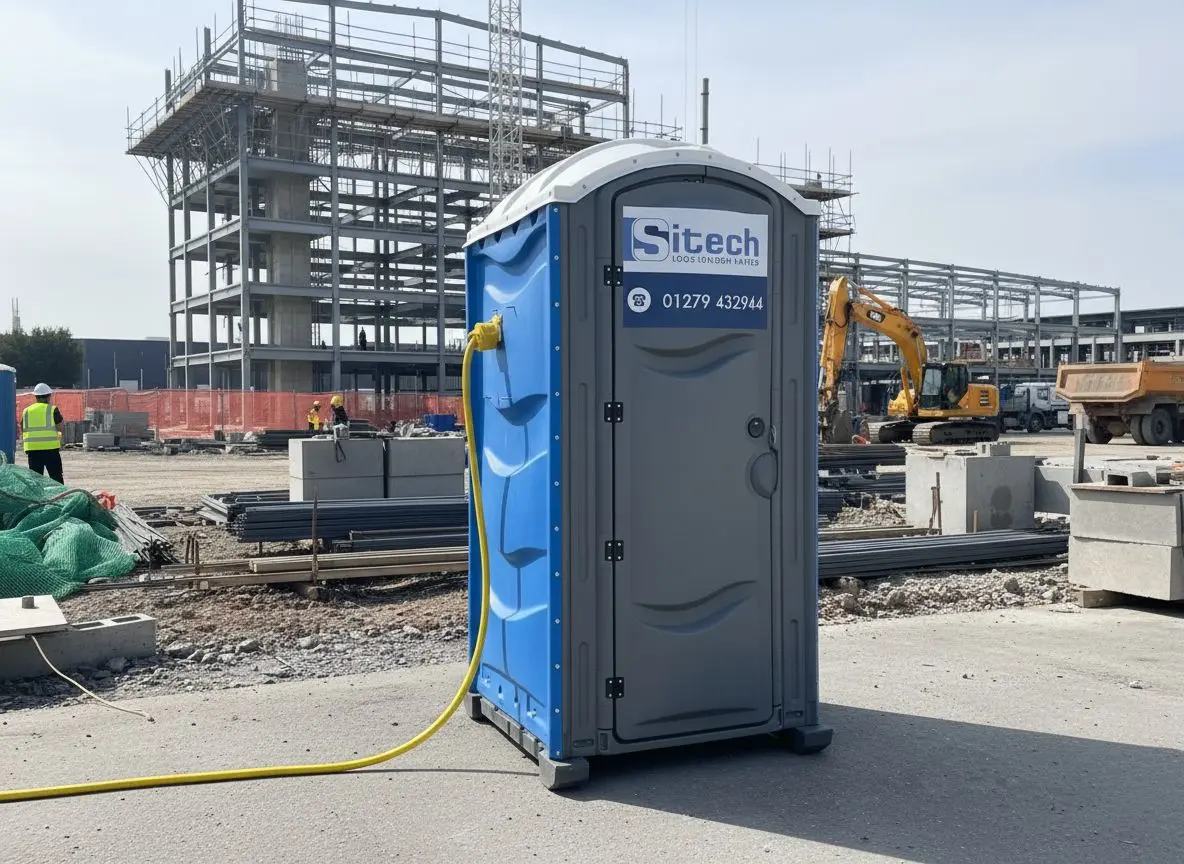
Safety is paramount on UK construction sites, which is why these units utilize a standard 110V connection. The unit connects via a yellow 16-amp plug (BS EN 60309), which is compatible with the vast majority of site transformers and generators used across London. This ensures that no specialist electrical work is typically required for installation; it is a “plug and play” solution for sites with existing 110V infrastructure.
Power Draw and Heater
The core of the unit is a 3kW heater. This heater is responsible for maintaining the water temperature and ensuring the internal components do not freeze.
- Power Consumption: The 3kW draw means the unit should be accounted for in the site’s power management plan. It requires a dedicated feed or a circuit that can handle the load without tripping, especially when the heater is active.
- Freeze Resistance: The internal heater warms the insulated tank area. This ambient heat helps prevent the water pump and internal pipework from freezing, ensuring the sink remains operational even when external temperatures drop below zero.
Water Supply Options
These units are generally available in two configurations. Self-contained units feature an internal water tank that is refilled during weekly servicing, making them ideal for sites without a mains water connection. Mains-connected units can be plumbed directly into a water supply for high-traffic areas, though this requires insulated pipework to prevent the supply line from freezing before it reaches the heated unit.
Installation is straightforward for any standard, professionally managed construction site. With power confirmed, the unit provides an immediate upgrade to site welfare.
London Site Logistics: ULEZ, Access, and Servicing
Logistics in London are uniquely challenging compared to the rest of the UK, with traffic restrictions, emissions zones, and tight site boundaries playing a major role in procurement decisions.
ULEZ and Transport
Sitech operates a fleet that is fully compliant with the Ultra Low Emission Zone (ULEZ) standards. This ensures that delivery and servicing vehicles can access sites anywhere in Greater London without incurring penalty charges or delays. This compliance is part of our commitment to sustainable operations within the capital.
Tight Site Access
Inner London sites often suffer from restricted access. Navigating narrow streets in the City or compact sites in residential boroughs requires experience. The 110V hot water toilet is designed with a compact footprint (typically approx. 1.2m x 1.2m), allowing it to fit into tight corners or designated welfare zones. Knowing these dimensions helps site managers plan their layout effectively before delivery.
Guaranteed Weekly Servicing
Reliability is the cornerstone of hygiene. Sitech provides comprehensive weekly servicing which includes waste removal, a deep clean of the unit, and restocking of consumables like soap and paper towels. According to the Waste Duty of Care Code of Practice, waste must be managed and disposed of correctly.[3] Our professional servicing ensures full adherence to these environmental regulations. Choosing a provider specializing in 110v hot water toilet hire London removes the logistical headaches associated with site welfare, ensuring units remain clean, functional, and compliant.
Frequently Asked Questions
Do construction sites require hot water toilets?
Yes, UK construction sites are required to provide hot or warm water for washing under HSE guidelines and the CDM Regulations 2015. While a standard toilet is mandatory, providing hot or warm water is crucial for ensuring facilities are “suitable and sufficient,” especially during winter.[1] This helps with effective cleaning, prevents health issues like dermatitis, and supports full legal compliance.
How to prevent portable toilets from freezing in winter?
The most reliable way to prevent a portable toilet from freezing is to hire a dedicated 110V hot water unit. These units contain an internal heater (typically 3kW) that keeps the water and components from freezing. While adding salt or specific additives to the flush tank can help, a heated unit is the only effective solution for maintaining operation in sub-zero temperatures.
What is the difference between 110V and 240V site toilets?
The main difference is the power source and application. 110V units are the UK construction industry standard for safety, running off site transformers with a yellow 16-amp plug. 240V units connect to a standard mains supply (blue plug) and are more common for long-term installations or events with access to domestic electricity, often featuring more amenities like lighting.
How many toilets are needed for a construction site in London?
The standard UK requirement, as per BS6465 and HSE guidance, is one toilet for every seven workers on a site.[1] For a 40-hour work week, this ratio ensures adequate provision. Site managers in London must calculate this based on the maximum number of personnel on-site at any one time to remain compliant.
Can you use methanol in chemical toilets?
No, you should not use methanol in chemical toilets as it is a hazardous, flammable substance. While sometimes incorrectly suggested as an antifreeze, it poses significant health and safety risks. Always use professionally formulated, non-flammable chemical toilet additives designed specifically for waste breakdown and odour control, especially those rated for winter use.
What are the HSE welfare facility requirements?
HSE requires that construction sites provide “suitable and sufficient” welfare facilities. This includes clean toilets (1 per 7 workers), washing facilities with hot or warm water, soap, and towels, a place to warm food and make hot drinks, and clean drinking water.[1] All facilities must be well-ventilated, lit, and kept in a sanitary condition.
How much power does a hot wash toilet use?
A typical 110V hot wash portable toilet uses a 3kW heater. This requires a connection to a 110V power supply via a 16-amp plug, which is standard on UK construction sites. The unit only draws significant power when the water heater is actively running, making it an efficient solution for providing on-demand hot water.
Do you need a mains connection for a hot water portable toilet?
No, you do not necessarily need a mains water connection. Many 110V hot water portable toilets are self-contained, with an internal water tank that is refilled during the weekly service. You only need a 110V power connection from a generator or site transformer to run the heater and pump. Mains-connected versions are also available for long-term sites.
Limitations, Alternatives & Professional Guidance
While 110V hot water units are a robust solution, site managers should be aware of certain limitations. Although HSE guidelines are clear on the need for warm water, the definition of “suitable” can vary depending on specific site conditions. Furthermore, the performance of any unit can be affected by extreme weather events dropping below -5°C or inconsistent power supply from on-site generators, which may interrupt the heating cycle.
If upgrading to fully heated toilets is not immediately feasible, alternative approaches exist. For a full breakdown of all unit types and pricing, see our complete guide to portable toilet rental. Standalone hot water hand wash stations can be hired to supplement existing cold chemical toilets, ensuring compliance with washing regulations. For sites considering a permanent connection, our guide on chemical vs mains connected portable toilets provides a detailed comparison. For larger sites with bigger budgets and more space, static welfare cabins offer centralized heating, washing, and canteen facilities, though these require significantly more room than portable units.
We strongly advise site managers to conduct a formal risk assessment for winter welfare. Consulting with a health and safety officer or a professional supplier like Sitech can help determine the best solution based on site size, duration, and personnel numbers.
Conclusion
110V hot water units are essential for winter compliance, superior hygiene, and worker morale. They solve the practical problems of freezing and ineffective cleaning that standard units face, ensuring that your workforce stays healthy and productive. Choosing the right unit is a key part of maintaining a safe site, making 110v hot water toilet hire London a critical consideration for any winter project.
Sitech’s 110V Hot Water Chemical Portable Toilet offers the reliability and compliance assurance your site needs. With ULEZ-compliant delivery and guaranteed weekly servicing, we handle the logistics so you can focus on the build.
Ready to winter-proof your site? Get Instant Quote online or call our team for a 30-minute response.
Service Areas
We deliver 110V hot water portable toilets across London and the South East:
- London - All 32 boroughs including Central London, Canary Wharf, and the City
- North London - Barnet, Enfield, Haringey, Islington, Camden
- South London - Croydon, Bromley, Lewisham, Greenwich, Southwark
- East London - Stratford, Barking, Dagenham, Newham, Tower Hamlets
- West London - Ealing, Hounslow, Hillingdon, Richmond, Hammersmith
- Hertfordshire - Watford, St Albans, Stevenage, Hemel Hempstead
- Essex - Chelmsford, Colchester, Basildon, Southend, Thurrock
- Kent - Maidstone, Canterbury, Dartford, Medway, Gravesend
Same-day delivery available across all areas. Contact us for availability.
References
- Health and Safety Executive (HSE). Construction - Welfare - Toilets and washing. HSE.gov.uk
- The National Archives. The Construction (Design and Management) Regulations 2015, Schedule 2. Legislation.gov.uk
- Department for Environment, Food & Rural Affairs. Waste duty of care: code of practice. Gov.uk
- The National Archives. The Workplace (Health, Safety and Welfare) Regulations 1992, Regulation 20. Legislation.gov.uk
References
- [1] https://www.hse.gov.uk/construction/healthrisks/welfare/toilets-and-washing.htm
- [2] https://www.legislation.gov.uk/uksi/2015/51/schedule/2
- [3] https://www.gov.uk/government/publications/waste-duty-of-care-code-of-practice/waste-duty-of-care-code-of-practice
- [4] https://www.legislation.gov.uk/uksi/1992/3004/regulation/20
Need Portable Toilets for Your Project?
Get a free quote for construction site toilets, event hire, or welfare facilities. Same-day response guaranteed.

Written by
Phil MosleyFounder & Director · Qualified Accountant
Has supplied welfare facilities to construction sites and events across London since 2002. Writes about portable sanitation, site regulations, and welfare compliance based on two decades of operational experience.
View all posts