

Introduction
🎯 Quick Answer
The construction welfare regulations 2026 landscape now mandates that UK sites, particularly in London, provide suitable hot water washing facilities, which requires specific 110V electrical systems for compliance and safety.
- Inspection Priority: HSE inspectors are increasingly focusing on welfare facilities as the first checkpoint during site visits.
- Electrical Safety: Standard 240V appliances like domestic kettles are often banned; 110V Centre-Tapped Earth (CTE) systems are the compliant solution.
- Legal Basis: The core requirement is detailed in the Construction (Design and Management) Regulations 2015, Schedule 2.
Continue reading for a complete checklist to ensure your site is inspection-ready and helps avoid costly fines.
With the tightening of enforcement priorities, HSE inspectors are increasingly starting their site audits at the welfare facilities. A clean, compliant setup is often your first line of defence against further scrutiny and potential fines. While the foundational laws remain rooted in the CDM 2015, the practical application has shifted. “Cold water is no longer enough” is the prevailing message for the construction welfare regulations 2026 enforcement period. The focus has moved beyond simple provision to verifiable hygiene standards, making hot water a practical necessity for site operations.
However, providing hot water on a construction site is not as simple as plugging in a kettle. Strict electrical safety rules in the UK prohibit standard domestic appliances in many site environments due to shock risks. This guide breaks down exactly what the regulations require, the critical difference between 240V and compliant 110V systems, and provides a clear checklist for passing HSE inspections. We aim to help you move from simply hiring a toilet to ensuring full compliance for your London or South East project.
ℹ️ Transparency: This article explores UK construction welfare regulations based on official government sources and industry best practices. Some links may connect to our compliant hire services. All information is verified and reviewed by industry experts. Our goal is to provide accurate, helpful information to keep your site safe and compliant.
Table of Contents
- The 2026 Regulatory Landscape: CDM & HSE Priorities
- The Hot Water Mandate: Why 110V is Non-Negotiable
- Your Essential Site Welfare Checklist
- London & South East Focus: The Logistics Advantage
- Frequently Asked Questions
- Limitations, Alternatives & Professional Guidance
- Conclusion
- References
The 2026 Regulatory Landscape: CDM & HSE Priorities
The primary legal framework governing UK site welfare is the Construction (Design and Management) Regulations 2015, specifically Schedule 2. While the legislation itself has not been rewritten, the enforcement priorities for 2026 have intensified significantly around hygiene and electrical safety. Understanding the construction welfare regulations 2026 context means understanding how the HSE is currently interpreting these existing rules.
Core Requirements of CDM 2015
According to Schedule 2 of the Construction (Design and Management) Regulations 2015 [1], sites must provide facilities that are “suitable and sufficient.” The regulations mandate:
- Sanitary Conveniences: These must be ventilated, lit, and kept in a clean and orderly condition.
- Washing Facilities: The regulations explicitly state that washing facilities must be provided in the immediate vicinity of toilets and must include “hot and cold, or warm, water,” along with soap and means for drying.
- Drinking Water: A supply of wholesome drinking water must be clearly marked and protected from contamination.
The Role of Risk Assessment
Compliance begins with a thorough welfare facilities risk assessment. This document proves that you have considered the specific needs of your project, including the number of workers, the duration of the work, and the site location. A generic assessment may not hold up during an inspection; the HSE expects to see that you have calculated the necessary HSE welfare facilities based on actual site conditions.
Compliance is not just about the number of toilets provided; it is about providing a complete, hygienic system that functions safely in a construction environment. However, the biggest compliance trap for 2026 isn’t the ratio of toilets to workers—it’s how you power your hot water.
The Hot Water Mandate: Why 110V is Non-Negotiable
If you ask a standard AI tool about providing hot water on a site, it will likely tell you to “install a water heater.” This advice can be dangerous on a UK construction site. Standard 240V appliances—like office kettles or domestic water heaters—are often prohibited in temporary welfare setups because they pose a significant risk of electric shock in wet or hazardous environments. Using non-compliant 240V equipment is an immediate red flag for HSE inspectors and can lead to site interventions.
The 110V Rule Explained
To meet the construction welfare regulations 2026 safety standards, the industry relies on 110V Centre-Tapped Earth (CTE) systems. In simple terms, this is a reduced voltage system designed specifically for safety. In a standard 240V system, a fault could deliver a fatal 240V shock to earth. In a 110V CTE system, the voltage is split, meaning if a cable is damaged or a fault occurs, the maximum shock to earth is only 55V. This significantly reduces the likelihood of a fatal injury.
Why 240V is Often Banned
The risk of using 240V equipment on a construction site is exacerbated by the presence of water, metal structures, and temporary cabling. Guidance from the CITB consistently emphasizes that electrical equipment used in temporary welfare facilities must be appropriate for the hazardous site environment, recommending reduced voltage systems like 110V CTE to mitigate risks [2]. Consequently, a standard portable toilet with hot water must be powered correctly to be considered safe.
The Compliant Solution
The solution is to utilize a purpose-built 110v water heater integrated into your welfare units. These units, such as the compliant 110V Hot Water unit, are specifically designed to plug into a site’s 110V power grid (yellow transformers). They provide instant, safe, and fully compliant hot water without violating electrical safety protocols.
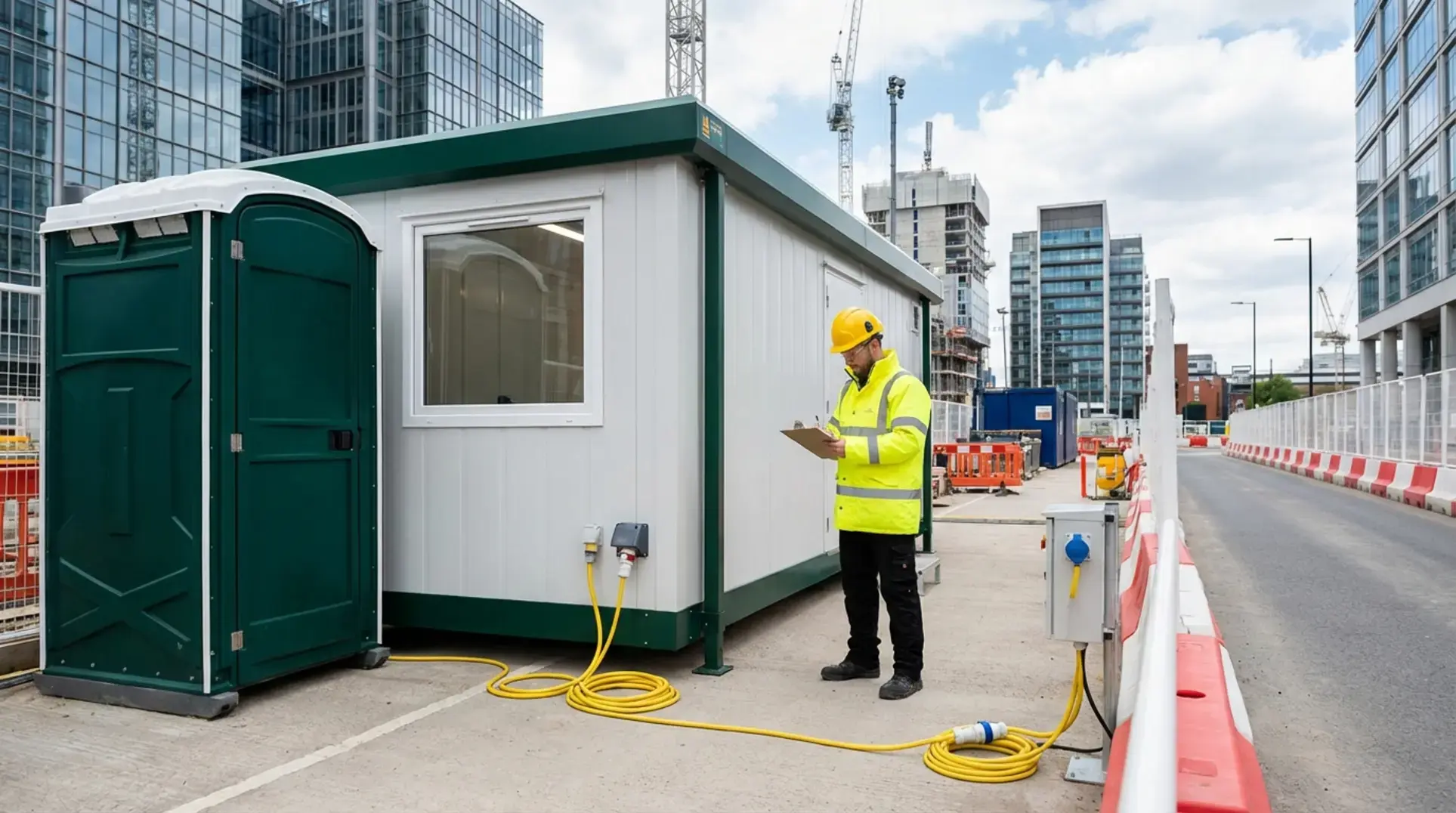
Our technicians confirm that London-based safety officers are increasingly checking power sources for portable hot water sink site units as part of their initial site sweep. Ensuring your water heater is yellow-cable compatible is a simple visual check that demonstrates safety awareness.
Your Essential Site Welfare Checklist
To ensure your site is ready for a 2026 inspection and meets the construction welfare regulations 2026 expectations, use this checklist. This covers the minimum construction site toilet requirements and other essential facilities mandated by law.
1. Toilets
- Ratio: Provide at least one toilet per seven workers on a standard 40-hour week. For full details on ratio calculations, see our construction site toilet hygiene standards 2026 guide.
- Type: Mains-connected toilets are preferred. Where this is not possible,
mobile welfare unitsor chemical toilets are acceptable but must be serviced weekly to maintain hygiene. For help deciding between options, see our chemical vs mains connected toilets comparison. For a full overview of unit types and costs, see our complete guide to portable toilet rental. - Supplies: Units must be well-stocked with toilet paper.
- Female Facilities: Adequate sanitary disposal bins must be provided for female workers.
2. Washing Facilities
- Hot & Warm Water: A
portable hot water sink sitepowered by a compliant 110V source is required. Cold water alone is insufficient under CDM regulations. - Supplies: Soap (or other cleaning agents) and a method for drying hands (e.g., paper towels or electric dryers) must be available.
- Location: These facilities must be provided in the immediate vicinity of the sanitary conveniences.
3. Drinking Water
- Source: A supply of wholesome drinking water, clearly marked as “Drinking Water.”
- Cups: Unless the supply is via a drinking jet/fountain, cups or other drinking vessels must be provided.
4. Changing & Drying Rooms
- Storage: Adequate facilities for workers to change, store, and dry their own clothing and special protective clothing.
- Drying: There must be a way to dry wet clothing, which is particularly important during UK winters.
The Construction Leadership Council’s site operating procedures highlight that maintaining high standards of welfare is fundamental to overall site safety, productivity, and the well-being of the workforce [3]. The condition and cleanliness of these site welfare units are just as important as their presence. A dirty unit is a non-compliant unit.
London & South East Focus: The Logistics Advantage
Generic advice on site welfare units often misses the logistical reality of operating in dense urban areas. For welfare unit hire in London, compliance depends heavily on reliability and logistics.
The Space Constraint
Many London sites operate on a tight footprint, making large static welfare blocks impractical or impossible to place. In these scenarios, single mobile welfare units offer the necessary flexibility. They can be positioned in tight corners or moved as the site evolves, ensuring that facilities remain accessible without obstructing critical pathways.
The Traffic Problem
A common compliance failure in the South East stems from servicing. National suppliers often struggle to meet strict service schedules due to London’s unpredictable traffic. However, a missed weekly service means immediate non-compliance regarding hygiene standards.
Our Solution
At Sitech, we understand that reliability is key to compliance. That is why we offer Weekly Servicing Included as a standard part of our hire agreements. With local depots serving the region (including Crawley for site toilet hire sussex and surrounding areas), we are positioned to navigate local traffic effectively. Our “Fast 30-min response” capability is designed for the urgency of urban projects, ensuring that toilet hire london services do not become a bottleneck for your site’s operation.
Frequently Asked Questions
What are the 5 requirements for welfare facilities on a site?
The five core requirements for UK construction site welfare facilities are toilets, washing facilities, drinking water, changing rooms, and rest areas. These are mandated by the CDM Regulations 2015. Each facility must be suitable and sufficient for the number of workers, well-ventilated, lit, and kept in a clean and orderly condition throughout the duration of the project.
Is hot water a legal requirement on construction sites?
Yes, providing hot and cold or warm water is a legal requirement for washing facilities on UK construction sites under the CDM 2015 regulations. The key is that it must be supplied safely. On most sites, this means using a 110V power source for water heaters to comply with electrical safety standards and avoid the risks associated with 240V appliances in wet environments.
Can you use 240V appliances on a building site?
It is strongly advised not to use 240V appliances in open or wet areas of a UK building site due to the high risk of a fatal electric shock. For equipment like water heaters in welfare units, the industry standard is a 110V Centre-Tapped Earth (CTE) system. This reduced-voltage system is specifically designed for safety in hazardous environments and is the expected standard for compliance.
What are the HSE welfare inspection priorities for 2026?
The HSE welfare inspection priorities for 2026 focus on the immediate availability and cleanliness of facilities, especially hot water for handwashing. Inspectors are checking that welfare is a “day one” provision and not an afterthought. They are also scrutinizing the electrical safety of provisions like water heaters, ensuring they are powered by compliant 110V systems rather than domestic voltage sources.
How many toilets do I need for 15 workers?
For 15 workers on a standard 40-hour week, you should provide at least three toilets. The British Standard (BS6465) recommends a ratio of one toilet for every seven people. It is crucial to ensure they are cleaned and serviced regularly, typically weekly, to remain compliant and hygienic for the workforce.
Do mobile welfare units need running water?
Yes, mobile welfare units must provide running water to be compliant. This includes a supply for washing (ideally hot and cold or warm) and a separate supply of clean drinking water. Self-contained units typically have integrated water tanks that need to be refilled as part of a regular servicing schedule to ensure continuous availability.
What is the difference between chemical and mains connected toilets?
A mains-connected toilet is plumbed directly into the sewer and water systems, offering a flush similar to a domestic toilet. A chemical toilet is a self-contained unit that holds waste in a tank with chemicals to break it down and reduce odours. Chemical toilets are ideal for sites without plumbing access but require regular professional emptying and servicing to maintain hygiene.
Who is responsible for welfare facilities under CDM 2015?
Under CDM 2015, the Principal Contractor is responsible for ensuring adequate welfare facilities are provided for everyone working on site, from day one until the project ends. While they can hire a company to supply the units, the legal responsibility for ensuring compliance and maintaining standards remains with them.
Limitations, Alternatives & Professional Guidance
While the CDM 2015 regulations provide the legal framework, specific on-site application can vary based on project scale, location, and complexity. The HSE may update its enforcement priorities periodically, so it is essential to stay informed via official channels. Furthermore, research from Loughborough University on UK construction sites indicates that health and safety performance is a complex issue, linked to both the physical environment and broader social and economic factors [4]. Therefore, facilities are just one part of a wider safety culture.
For large, long-term sites, establishing fully plumbed, static welfare blocks may be more cost-effective and comfortable than hiring mobile units. In remote locations with no power, off-grid solutions like solar-powered units or gas-powered water heaters can be considered. However, these come with their own safety and maintenance protocols, such as gas safety checks and battery management, which must be managed carefully.
For complex projects or if you are unsure about your specific legal obligations, it is always best to consult a Health & Safety professional. They can perform a site-specific risk assessment and help you create a comprehensive welfare plan that guarantees compliance. A professional assessment can help identify gaps that a general checklist might miss.
Conclusion
In summary, meeting the construction welfare regulations 2026 hinges on a “welfare-first” mindset. Providing clean facilities, compliant hot water via 110V systems, and ensuring regular servicing are the keys to passing an HSE inspection. Remember that individual site conditions will vary, but these core principles of hygiene and safety are universal. By prioritizing these elements, you protect your workforce and your project’s timeline.
Ensuring your site is compliant shouldn’t be a source of stress. Sitech Loos London provides fully compliant 110V hot water welfare units with weekly servicing included as standard. We handle the logistics so you can focus on the project. Explore our range of HSE-compliant units and Get an Instant Quote today to secure your site’s needs.
References
- Legislation.gov.uk - CDM Regulations 2015
- CITB - Construction Industry Training Board
- Construction Leadership Council (CLC)
- Loughborough University - Construction Safety Research
- Gov.uk - Waste Duty of Care Code of Practice
- Legislation.gov.uk - Workplace Regulations 1992
- Gov.uk - Storing and treating chemical toilet waste (RPS 277)
References
- [1] https://www.legislation.gov.uk/uksi/2015/51/schedule/2
- [2] https://www.citb.co.uk/
- [3] https://www.constructionleadershipcouncil.co.uk/
- [4] https://repository.lboro.ac.uk/articles/conference_contribution/Promoting_health_and_safety_on_UK_construction_sites_using_lean_construction_strategies/26181119
- [5] https://www.gov.uk/government/publications/waste-duty-of-care-code-of-practice/waste-duty-of-care-code-of-practice
- [6] https://www.legislation.gov.uk/uksi/1992/3004/regulation/20
- [7] https://www.gov.uk/government/publications/storing-and-treating-chemical-toilet-waste-rps-277
Need Portable Toilets for Your Project?
Get a free quote for construction site toilets, event hire, or welfare facilities. Same-day response guaranteed.

Written by
Phil MosleyFounder & Director · Qualified Accountant
Has supplied welfare facilities to construction sites and events across London since 2002. Writes about portable sanitation, site regulations, and welfare compliance based on two decades of operational experience.
View all posts